

 Oct 11, 2026
 4 min read


White Label vs Private Label vs OEM: Bedding Explained
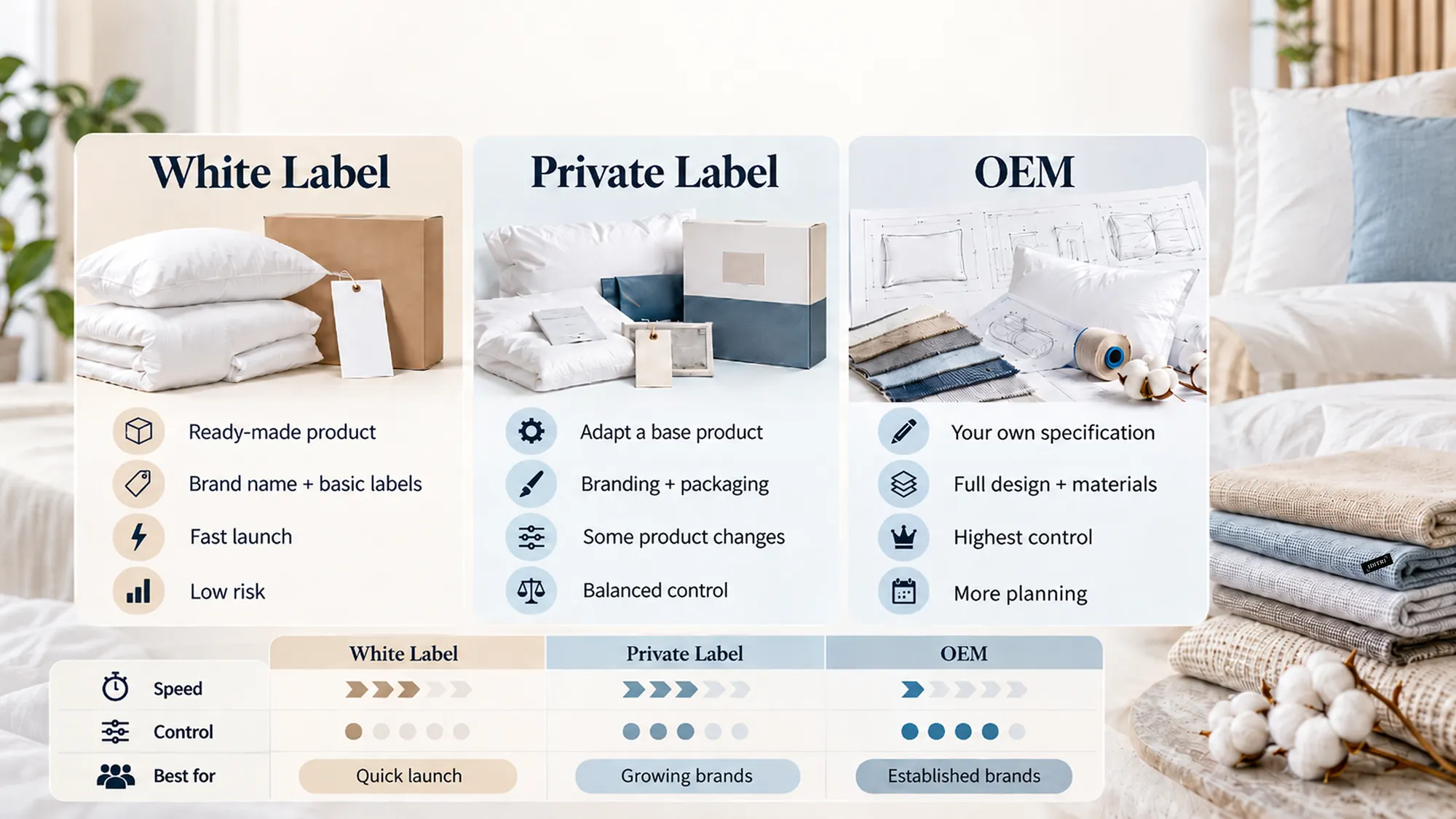
White label, private label and OEM are three of the most confused terms in bedding supply. They describe different levels of control over the product, and choosing the wrong one costs time and money. Here is a plain-language comparison for brands and sellers.
| Model | Who designs the product | What you customise | Best for |
|---|---|---|---|
| White label | The manufacturer; a ready-made product | Brand name and basic labelling | A fast launch with low risk |
| Private label | Shared; you select and adapt a base product | Branding, packaging and some product details | Brands that want a distinct look |
| OEM | You, to your own specification | The full design, materials and finish | Established brands with their own designs |
White Label: Fast and Simple
With white label, the manufacturer’s existing product carries your brand. There is almost no development work, so you can launch within weeks. It also suits sellers who want to test several products quickly before committing to one. The advantage is low effort and low setup cost. The limitation is that other sellers may offer the same product under a different name, which makes it harder to stand out on price or features.
Private Label: A Balanced Choice
Private label starts from a proven product and lets you shape it. You might change the cover fabric, adjust the size, add custom packaging or build a branded range of cervical and contour pillows. It is the model most growing brands choose because it balances speed, control and cost. The trade-off is that customisation can raise the MOQ and lengthen lead times, because materials and packaging must be sourced and approved first.
OEM: Full Control
In an OEM arrangement you supply the design or specification and the manufacturer builds it exactly as written. This gives the most control and a product competitors cannot easily copy, but it demands more planning, technical detail and volume. Development effort, commitments and timelines are all higher.
A Practical Example
Imagine an online seller launching a neck-support pillow. With white label, they add their logo to an existing cervical pillow and list it within weeks. With private label, they also change the cover and create a branded box. With OEM, they bring a new contour design and have it produced to their own drawing.
Cost and Timeline Compared
White label is usually quickest and cheapest to start, because the product already exists. Private label costs more because of customisation, but less than OEM. OEM carries the highest upfront effort, since materials, specifications and sometimes tooling must be agreed first. Exact figures depend on your product, so request a quotation for each option rather than guessing.
Three Common Misunderstandings
“White label means low quality.” Quality depends on the manufacturer and its checks, not on the label model. “Private label means I own the product design.” You usually own the brand, while the base product stays with the manufacturer, so ask who owns artwork, labels and any new specifications. “OEM is always better.” It only pays off for brands with the volume and technical detail to support it.
Questions to Ask Before You Choose
Whichever model you lean towards, put a few questions to your manufacturer. Which models do you offer, and what exactly is included in each? Can I change the cover, size or shape of an existing product? How do MOQs and lead times differ between models? Who owns the artwork, labels and any new specifications? Clear answers here prevent expensive surprises later.
Moving Between Models
Brands rarely stay in one model forever. Many begin with white label to test demand, move to private label once sales are steady, and consider OEM when volumes justify a unique design. A manufacturer that supports all three lets you grow without changing supplier or repeating the sample process.
“Start with the model that matches your stage, and move up as your brand and volumes grow.”
Talk to a Manufacturer Early
The right model often becomes clear in a conversation about your quantity, budget and goals. Our private label team can explain what is possible across our product range, and you can request a quote when you are ready. For a step-by-step plan, read how to start a private label pillow brand.