
 Oct 8, 2026
 4 min read


Quality Control in Pillow Manufacturing: What Buyers Should Expect
Good pillows are not rescued by a final inspection. They are made well from the first step, and checked at every stage along the way. For buyers, understanding that process is the best defence against inconsistent batches. Here is what quality control should look like inside a memory foam pillow factory, and what you can reasonably ask to see.
Why Quality Is Built In, Not Added at the End
A final check can catch a faulty pillow, but it cannot fix poor foam, uneven cutting or weak stitching. The factories that deliver consistent orders treat each stage as its own checkpoint. When one team passes a problem to the next, the cost of fixing it grows. That is why a manufacturer that controls the whole process in-house has a natural advantage in consistency and timelines.
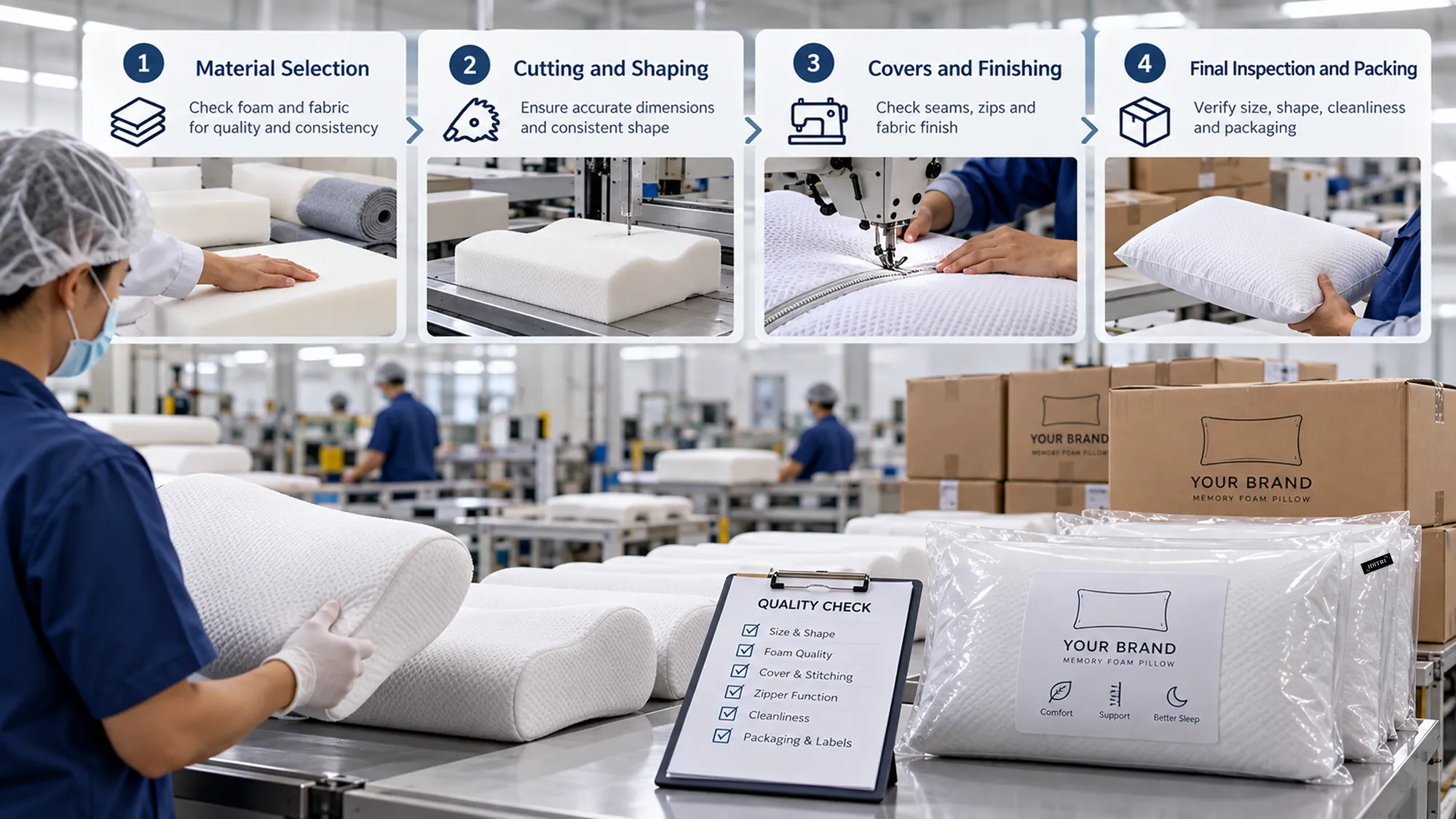
Stage 1: Material Selection
Everything starts with the memory foam and the cover fabric. Incoming foam should be checked for firmness, density and surface condition before it is cut, and fabric should be checked for colour, feel and defects. Rejecting weak material here costs almost nothing, while discovering it after assembly costs the whole unit. A supplier that records batch details can also trace any later problem back to its source and correct it quickly.
Stage 2: Cutting and Shaping
Accurate cutting decides whether a pillow matches its specification. For contour and cervical designs, the curve must be consistent from one piece to the next, otherwise customers feel the difference. Operators should measure samples against the approved dimensions throughout the run, not just at the start.
Stage 3: Covers and Finishing
Covers are where many complaints begin. Seams, zips and fabric fit all need checking, and loose threads or uneven stitching should be corrected before assembly. A neat finish is also the first thing your customer notices, so it directly affects your reviews.
Stage 4: Final Inspection and Packing
Finished pillows are inspected for shape, size, cleanliness and appearance, then packed in secure packaging that protects them in transit. For export and marketplace orders, labels, barcodes and carton markings are verified at this point as well. Compressed packing deserves care too, so the foam recovers fully when the customer opens it. A pillow that leaves the factory perfect but arrives crushed is still a defective pillow.
Common Defects and Where They Start
Most defects trace back to one stage, which makes them easier to prevent once you know where to look. Lumps and hard spots usually start at foam cutting. Strong odours often come from insufficient airing before packing. Loose threads, uneven seams and zips that catch come from covers and finishing. Damaged or dirty pillows usually trace to packing and handling. When a problem appears, ask your supplier which stage it came from and what changed there. A mature factory answers precisely and fixes the cause, not just the unit.
Quality and Repeat Orders
Quality control matters most on the second and third order, when the novelty of a new supplier has worn off. Ask how the factory keeps materials and settings consistent between batches, how it records what was used, and whether it keeps reference samples. Documentation sounds dull, but it is what allows a factory to reproduce your approved pillow exactly.
What Buyers Can Ask For
You do not need to run the inspections yourself, but you can ask for evidence that they happen:
- a written description of the checks done at each stage
- photos or a short video of the finished lot before dispatch
- a reference sample kept by both sides for comparison
- a clear process for replacing or crediting faulty units
“Consistency is not an accident. It is the result of checking the small things at every stage.”
Inspect on Your Side Too
Whatever the supplier does, build your own checks into your process: approve a sample, review pre-shipment photos and inspect goods on arrival. Two layers of checking catch what one layer misses.
See the Process for Yourself
Read how we work on our manufacturing page, or ask for samples and a specification sheet. If you want to test foam yourself, our guide on evaluating memory foam quality explains simple hands-on checks, and you can request a quote whenever you are ready.